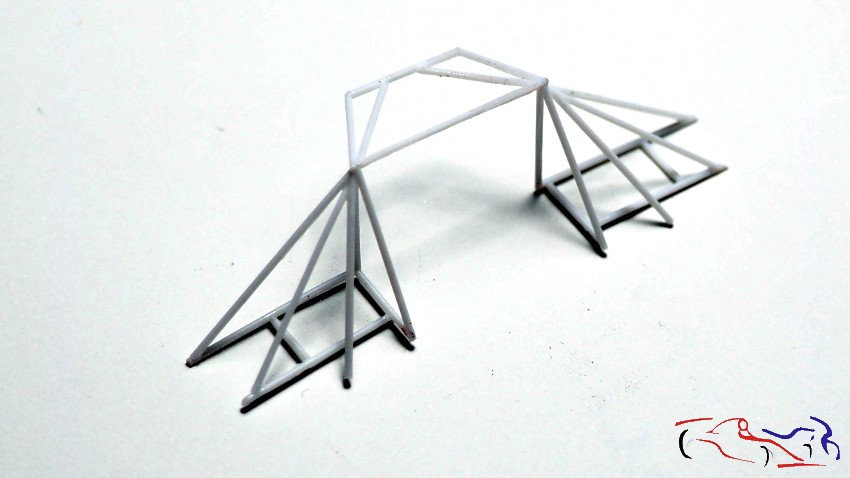
Hola a todos. Con el paso del tiempo, me he dado cuenta que mis progresos en modelismo están estancados en cuanto tengo que hacer piezas complejas y pequeñas, y pintarlas posteriormente, por que con mis manos, las herramientas y los materieles existentes, no me permiten llegar a ellas. Así pues, y viendo los que otros modelistas o artesanos pueden llegar a hacer, estoy trabajando en el modelado 3D con el programa Fusion desde Enero. Mi idea con este aprendizaje, es llegar obtener las piezas necesarias para detallar mis kits, y así, continuar con mi aprendizaje modelístico y que no se quede estancado.
Hello everyone. Over time, I’ve realized that my progress in model making has stalled when I have to create and paint small or complex pieces, because my hands, tools, and available materials simply don’t allow me to achieve that level of detail. So, seeing what other modelers and craftspeople can accomplish, I’ve been working on 3D modeling with Fusion since January. My goal with this learning process is to create the necessary pieces to detail my kits, thus continuing my modeling development and preventing it from stagnating.
El programa Fusión es muy fácil e intuitivo en cuanto coges la idea de como preparar las piezas. Mi amigo Mario Vallina, me ha ayudado mucho a la hora de entrar en esta aplicación, y junto a los videos que hay en Youtube, en estos dos meses he avanzado mucho. He de decir que me gusta el diseño de piezas y el dibujo técnico, por lo que algo ya tenía de base. Y hasta que no tenga una propia impresora, donde pueda obtener las piezas fisicas, he empezado a hacer diseños sin medidas exactas y a ojo, de piezas que, o me han costado hacerlas desde cero, o que pueda necesitar en futuros kits que tengo pendientes de hacer. Deciros que son pruebas y que pueden no ser exactamente como las piezas reales, que les falten partes o curvaturas. SOn trabajos para conocer la herramienta. Y empezamos con ellas:
The Fusion program is very easy and intuitive once you grasp how to prepare the parts. My friend Mario Vallina has been a great help in getting started with this application, and along with the videos on YouTube, I’ve made a lot of progress in these two months. I should mention that I enjoy parts design and technical drawing, so I already had some basic knowledge. Until I have my own printer where I can obtain physical parts, I’ve started making designs without exact measurements, just eyeballing them. These are parts that were either difficult to make from scratch or that I might need in future kits I have planned. These are just tests, and they may not be exactly like the real parts; they might be missing pieces or have curves. They’re exercises to familiarize myself with the tool. So, let’s begin:
Amortiguador de coche de competición:
Racing car shock absorber:
Del BMW M3 E 30, tengo todas estas piezas:
From the BMW M3 E30, I have all these parts:
Repartidor de frenos:
Brake proportioning valve:
Entrada de aire que tiene delande del parabrisas:
Air intake located in front of the windshield:
Caja de fusibles:
Fuse box:
Conjunto de base y bisagra del capo, pieza conjunta y despiece:
Hood base and hinge assembly, joint and parts breakdown:
Entrada de aire de coches de los años 80 o 90:
Car air intake from the 80s or 90s:
Llanta Braid de los años 80 y 90 de los campeonatos españoles:
Braid rim from the 80s and 90s used in the Spanish championships:
Fijación del volante en turismos de competición:
Steering wheel mounting in racing cars:
Corta corriente:
Cut off the power:
Bisagra porton Lancia Delta S4:
Lancia Delta S4 tailgate hinge:
Bisagra usada en Lancia:
Hinge used in Lancia cars:
Bisagra portón del Lancia 037:
Lancia 037 tailgate hinge:
Bisagra puertas del Land Rover modelo 88 o 109:
Door hinges for Land Rover model 88 or 109:
Bisagra y su despiece:
Hinge and its parts breakdown:
Hasta aquí he llegado y espero ir poniéndoos mis progresos. Espero que os guste!
This is as far as I’ve gotten, and I hope to keep you updated on my progress. I hope you like it!
Hola a todos!! Un buen empujón he dado al interior, ahora que tengo más tiempo!! Pero empecemos por una pieza terminada a falta de imprimar y pintar, que se hará con la carrocería. En el capço del motor, he colocado las fijaciones para su apertura y para su cierre, que ya había realizado. Para fijar los cierres, directamentehe taladrado el capó y pegado el vástago, para cortarlo y alisarlo una vez seco, De esta manera, aseguro su fijación.
Hi everyone! I’ve made good progress on the interior now that I have more time! But let’s start with a finished piece that just needs priming and painting, which will be done with the body. On the hood, I’ve attached the fasteners for opening and closing it, which I had already made. To secure the fasteners, I drilled directly into the hood and glued the pin in place, then cut and smoothed it once it was dry. This way, I ensured it was securely attached.
Continuamos con el asiento. Lo primero que hago son las fijaciones al suelo del coche, con una lámina de metal tallada, y una tira de plástico taladrada. Para su posterior fijación al asiento, taladro los agujeros para introducir los correspondientes tornillos de metal. Después, pinto dichas piezas con negro satinado y la parte trasera del asiento, de negro brillante. Una vez seco, lo enmascaro para pintar la parte delantera del asiento con negro mate y polvos de talco, simulando esa textura característica. Quitamos la cinta de enmascarar y ya tenemos listo el asiento para poner los cinturones:
We continue with the seat. The first thing I do is attach it to the car floor using a carved metal sheet and a drilled plastic strip. To attach it to the seat, I drill holes for the corresponding metal screws. Then, I paint these pieces with satin black and the back of the seat with gloss black. Once dry, I mask it off and paint the front of the seat with matte black and talcum powder, simulating that characteristic texture. We remove the masking tape, and the seat is ready for the seatbelts.
En este caso, los cinturones los voy a hacer partiendo de esparadrapo quirúrgico, que corto y pinto con negro mate. Les pongo las ebillas con mucho cuidado ya que tiene pegamento por su cara posterior. Para eso me ayudo de una peana metálica, donde aprovecho para poner las calcas de dichos cinturones, fijadas con el liquido de Tameo “Strong”, que deja la calca como la superficie en la que se coloca. Pegamos las fijaciones del asiento con sus tornillos y los cinturones, excepto los superiores, que se tienen que colocar después del arco de seguridad:
In this case, I’m going to make the seatbelts from surgical tape, which I cut and paint matte black. I attach the buckles very carefully since they have adhesive on the back. I use a metal base for this, where I also apply the seatbelt decals, fixed with Tameo “Strong” adhesive, which makes the decal adhere to the surface it’s placed on. Then I glue on the seat fixings with their screws and the seatbelts, except for the upper ones, which need to be attached after the roll cage.
Al mismo tiempo, vamos pintando más piezas de negro satinado, el extinror y unos botones de rojo, asi como las palometas de cierre de dos tapas del habitáculo.
At the same time, we are painting more parts in satin black, the fire extinguisher and some buttons in red, as well as the wing nuts for closing two compartment covers.
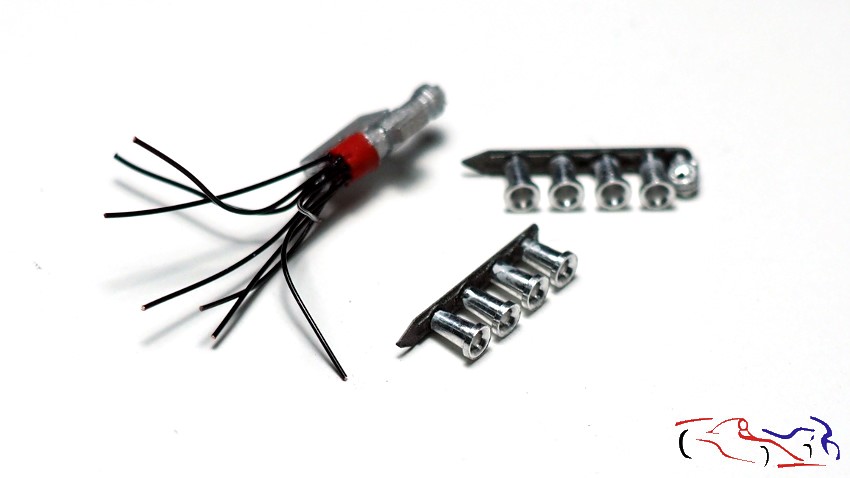
Y para terminar esta serie antes de acometer el habitáculo, os muestro la caja de fusibles con sus cables y tornillos de fijación, el conector Anderson (en rojo) o un manojo de cables que van a la caja de fusibles, pegados dentro de un tubo termorretractil:
And to finish this series before tackling the interior, I’ll show you the fuse box with its cables and fixing screws, the Anderson connector (in red) or a bundle of cables going to the fuse box, glued inside a heat-shrink tube:
Y pasamos al detallado del habitáculo. Empezamos poniendo dos cables que recorren el espacio longitudinalmente de forma paralela y que creo que corresponden a los conductos de aceite de los frenos traseros. Estos van pegados poco a poco con ciano al suelo, poniendo después unas tiritas de cinta cromada autoadesiva:
And now we move on to detailing the interior. We start by placing two cables that run parallel to each other lengthwise, which I believe correspond to the rear brake oil lines. These are gradually glued to the floor with cyanoacrylate, followed by strips of self-adhesive chrome tape.
Justo encima de los tubos del freno, colocamos el repartidor de frenada, no sin muchos problemas, por lo complejo de la pieza. Al final, el resultado es aceptable, con todas sus conexiones tanto haciea delante como hacia atrás, con esos tubos azules. Tamboen vemos por donde va el tubo termorretractil, con una primera forma dada con un alambre interior:
Just above the brake lines, we placed the brake proportioning valve, not without considerable difficulty due to the complexity of the part. In the end, the result is acceptable, with all its connections both front and rear, including those blue lines. We can also see where the heat-shrink tubing goes, initially shaped with an internal wire.
Colocamos una caja roja con varios conectores en el respaldo posterior y empezamos a simular cables, introducidos en el tubo termorretractil principal, al que vamos dando la forma que tendrá finalmente. A este tubo, le iremos añadiendo otros tubos o cables a lo largo de su recorrido, como vemos en la segunad foto: sobre esa base, y una vez ajustada la forma del tubo, añado cables haciendo pequeños agujeros. En el caso de otros tubos, les hago unos cortes logitudinales para abrir el tubo, separando cada lado del tubo que pego sobre el principal, como se ve en el de los cables rojos de los fusibles:
We placed a red box with several connectors on the back of the unit and began simulating cables, inserting them into the main heat-shrink tubing, shaping it into its final form. We added other tubes or cables along its length, as seen in the second photo: once the tube’s shape was adjusted, I added cables by making small holes. For other tubes, I made longitudinal cuts to open them, separating each side of the tube that I glued onto the main one, as seen with the red fuse wires.
Al msimo tiempo, también voy creando otras piezas añadiendo cables tanto al salpicadero como al arco de seguridad:
At the same time, I’m also creating other parts by adding cables to both the dashboard and the roll bar:
Y ahora toca colocar el tubo principal al cockpit. COmo veis, me ayudo de una bridas de plástico blanco estirado, asi como de una cinta de enmascarar negra de 0,5 mm.
And now it’s time to attach the main tube to the cockpit. As you can see, I’m using some stretched white plastic cable ties and 0.5 mm black masking tape.
A continuación, una serie de fotos con el arco de esguridad ya puesto a modo de test:
Below is a series of photos with the safety arch already installed for testing purposes:
Mas piezas nuevas: ese bloque parace ser que es del frno ABS, pero no estoy seguro, y los pedales con el repartidor de frenada a la derecha:
More new parts: that block seems to be for the ABS brake, but I’m not sure, and the pedals with the brake bias adjuster on the right:
Vamos añadiendo más detalles: el asiento, el extintor, la palanca de cambios, el cable de cortacorriente y las tapas traseras, todo con sus cables correspondientes:
Let’s add more details: the seat, the fire extinguisher, the gear lever, the kill switch cable, and the rear covers, all with their corresponding cables:
En cuanto al arco de seguridad, ya tenemos todo listo y pegado para añadirlo al conjunto:
As for the role cage, we have everything ready and glued to add it to the assembly:
Y para terminar, una serie de fotos con todo conectado y pegado: el cockpit está terminado a falta del salpicadero!!
And finally, a series of photos with everything connected and glued: the cockpit is finished except for the dashboard!
Hola a todos. Después de mucho tiempo sin subir actualizaciones, hoy toca actualizar este proyecto, con todo lo que he ido haciendo. Y para empezar, unas vistas de los encajes de las puertas tanto en la carrocería como en las propias puertas. En las fotos siguientes, podéis ver lo que se ha modificado para que encajen tal y como ocurre en el modelo real, incluyendo la muesca en la puerta donde se introduce el cierre:
Hello everyone. After a long time without posting updates, today I’m updating this project with everything I’ve been working on. To start, here are some views of the door fits, both on the body and on the doors themselves. In the following photos, you can see what has been modified to make them fit just like on the real model, including the notch in the door where the latch is inserted:
A continuación, os muestro la bandeja donde irá la bisagra del capó:
Next, I’ll show you the tray where the hood hinge will go:
Y si montamos todo para ver encajes, tenemos el conjunto de la carrocería con las puertas abiertas:
And if we assemble everything to check the fit, we have the complete body with the doors open:
A continuación, tres fotografías del chasis con el cockpit, el arco de seguridad y el salpicadero colocados:
Below are three photographs of the chassis with the cockpit, roll cage, and dashboard in place:
Y después de mostrar como va el conjunto, pasamos a las piezas nuevas que he realizado. Empezamos con los cierres y bisagras del capó. La primera foto, os muestro las fijaciones del capó, que van situadas en la parte más cercana al cristal. Están realizadas con plasticar con sus respectivos agujeros. En las dos siguientes fotos, vemos las piezas que irán en el capó, en la parte delantera, y donde se abatirá para abrirse. Los extremos de los palitos verticales irán colocados en la parte del chasis, en la bandeja que he mostrado anteriormente.
And after showing how the assembly is coming together, we move on to the new parts I’ve made. We’ll start with the hood latches and hinges. In the first photo, I’m showing you the hood fasteners, which are located on the side closest to the windshield. They’re made of plasticine with their respective holes. In the next two photos, you can see the pieces that will go on the front of the hood, where it will fold down to open. The ends of the vertical rods will be attached to the chassis, on the tray I showed earlier.
Pasamos al guarnecido de las puertas, que lo dejamos a falta de poner la parte central. Viendo fotos de un M3 de la escudería Bigazzi, que es el que llevaba Perez Sala en esta carrera, ese interior era como un tapizado de sofá, como si fuese tela. Y pensando como hacerlo, vi que las rejillas de Tameo eran muy parecidas y me puse con ello. Con masilla epoxy, hice una bola que al ponerla entre dos trozos de papel de hornear (de cocina), y pasándole un rodillo (el mango gordo de un cutter), logrè que fuera lo más fina posible. Una vez afinada, le puse la malla encima, y le volví a pasar el mango del cutter para que el entramado se marcara en la masilla. El siguiente paso, una vez seca, fue marcarla con la muestra y cortarla con exceso, para afinarla con limas y lijas. a su vez, también le rebajé el grosor lo más que pude para que se enrasara con el resto del guarnecido.
We moved on to the door trim, which we left unfinished except for the center section. Looking at photos of a Bigazzi M3, the one Perez Sala was driving in this race, the interior was like sofa upholstery, almost like fabric. Thinking about how to replicate it, I saw that Tameo’s grilles were very similar, so I got to work. Using epoxy putty, I made a ball, placed it between two pieces of parchment paper, and rolled it out with a roller (the thick handle of a utility knife) until it was as thin as possible. Once thinned, I placed the mesh on top and rolled it again with the utility knife handle to imprint the pattern onto the putty. The next step, once it was dry, was to trace it with the sample and cut off the excess, then smooth it down with files and sandpaper. I also reduced its thickness as much as possible so it would be flush with the rest of the trim.
Incluyo una foto posterior, para que se vea como queda el guarnecido imprimado, con su trama en el centro:
I’ve included a later photo so you can see how the primed trim looks, with its pattern in the center:
El siguiente paso era hacer los tiradores (o reposabrazos). Tomé varilla de plástico, que doblé con calor, y después, tocaba cortar y modelar con limas y lijas, dando la forma correcta. Podemos ver en la segunda foro, la pieza de resina que hice con masilla epoxy.
The next step was to make the handles (or armrests). I took plastic rod, which I bent with heat, and then cut and shaped it with files and sandpaper, giving it the correct form. You can see the resin piece I made with epoxy putty in the second photo.
Continuamos con más piezas del guarnecido, y ahora es el turno del picaporte. Lo hice en plástico, agujereando posteriormente su lugar en la pieza de masilla epoxy. Para hacerlo y que quedaran en el mismo sitio, junté las piezas de las dos puertas. Se puede observar que no siempre hacemos las piezas del mismo tamaño…..
We continue with more trim pieces, and now it’s the door handle’s turn. I made it from plastic, later drilling holes for it in the epoxy putty piece. To make sure they were in the same place, I joined the pieces from both doors. You can see that we don’t always make the pieces the same size…
Y aquí vemos como queda el conjunto superpuesto. Falta el elevalunas, que también está en camino!!
And here’s how the assembly looks when it’s stacked up. The window regulator is missing, but it’s on its way!
Pasamos al cockpit. Justo donde va la palanca de cambios, el coche lleva un refuerzo, que hice con capsula de botella de vino. Pero el kit tenía una forma no correcta, ya que en el coche real, el cambio de plano en el tunel de la transmisión más retrasado. Por tanto, añadimos varios trozos de láminas de plástico pegadas entre ellas. Aprovechamos a eliminar los registros de la parte trasera, para fabricar unos desde cero. Una vez seco el pegamento, lo limo y le pongo masilla UV por todos lados, que hago curar con la luz correspondiente.
We moved on to the cockpit. Right where the gearshift is, the car has a reinforcement, which I made from a wine bottle capsule. But the kit was the wrong shape, since in the real car, the plane change in the transmission tunnel is further back. Therefore, we added several pieces of plastic sheeting glued together. We took the opportunity to remove the access panels at the rear, to make new ones from scratch. Once the glue was dry, I sanded it down and applied UV putty all over, which I cured under the appropriate light.
Una vez lijada la resina UV y con la pieza pegada, necesitamos hacer los pedales y el reposapies. EMpezando por este último, hacemos una máscara marcando los bordes de corte asi como el lugar donde va el acelerador, y el hueco a la izquierda donde va el reposapies del pie izquierdo. Lo pasamos a una lámina de plástico y vemos su encaje. A su vez comenzaamos a dar forma a los pedales, teniendo el pedal de embrague y freno en un conjunto, y el acelerador por separado. Estos se han realizado con plástico tallado, tiras y redondos de plástico, y tubos de metal.
Once the UV resin has been sanded and the piece glued in place, we need to make the pedals and the footrest. Starting with the footrest, we make a mask, marking the cutting edges as well as the location for the accelerator and the space on the left for the left footrest. We transfer this to a sheet of plastic and check how it fits. Next, we begin shaping the pedals, keeping the clutch and brake pedals as a single unit, and the accelerator pedal as a separate unit. These were made with carved plastic, plastic strips and rounds, and metal tubing.
Continuamos con el interior, recreando la pieza donde van los fusibles, situada al lado del asiento, sobre el tunel central. Como son 8 fusibles, empiezo cortando y pegando una tira a la que he redondeado un poco las aristas, para que al pegarlos entre si, con ayuda de un soporte metálico, den la sensación de bloques distintos. Posteriormente, se añaden trocitos de redondo de plástico como si fueran las tapas donde van los propios fusibles, y se pega el cojunto a un soporte realizado en plástico como se ve en la segunda foto. Además, cada uno de esos fusibles lleva conectado en su parte inferior, un cable con una capucha de goma, que realizo con una camisa de cable que agrando e introduzco en el propio cable rojo. Más adelante lo cortaré y lo pegaré a cada fusible previo agujero hecho con broca de 0,3 mm.
We continue with the interior, recreating the fuse box located next to the seat, above the central tunnel. Since there are eight fuses, I start by cutting and gluing a strip of material with slightly rounded edges. This way, when glued together with a metal support, they’ll appear as distinct blocks. Next, small pieces of round plastic are added as fuse covers, and the assembly is glued to a plastic support, as seen in the second photo. Each fuse also has a wire with a rubber boot connected to its underside. I make this boot from a length of wire insulation, which I enlarge and insert into the red wire. Later, I’ll cut the rubber boot and glue it to each fuse after drilling a 0.3 mm hole.
Mientras tanto, pinto de blanco LP de tamiya la cuna y el arco de seguridad, habiendo realizado agujeros en el cockpit para los distintos aparatos, entradas de cable o sopòrtes de lo que vaya a incluir.
Meanwhile, I paint the cradle and safety arch with Tamiya LP white, having made holes in the cockpit for the various devices, cable entry points or supports for whatever I am going to include.
Por último en este post, imprimo y pinto todas las piezas del interior. Destacar la trama del guarnecido de la puerta, o el repartidor de frenada de la ultima fotografia que me dio mucha guerra, tanto al hjacerlo como al montarlo en el cockpit. Pero esto ya lo cuento en el siguiente post.
Finally, in this post, I’m printing and painting all the interior parts. I’d like to highlight the door trim pattern and the brake bias adjuster in the last photo, which gave me a lot of trouble, both making it and mounting it in the cockpit. But I’ll talk about that in the next post.
Mucho tiempo hace del anterior post. Cambios en la cueva están haciendo que me retrase en este proyecto, pero por ello, no para!! Para empezar hoy, lo primero es poner lo que me faltó del anterior post: la colocación donde las bisagras del capó girarán en el propio capot. De momento están pegadas temporalmente y para saber su posicion correcta, las he rodeado con cinta de enmascarar:
It’s been a long time since my last post. Changes in the cave are delaying this project, but it won’t stop there! To start today, the first thing I need to do is add what I missed from the previous post: the placement of where the hood hinges will rotate on the hood itself. For now, they’re temporarily glued, and to ensure their correct position, I’ve surrounded them with masking tape:
Y pasamos a las puertas, y lo primero que hago es rebajar el borde trasero del cristal, para que enaje en la carrocería al cerrar la puertas, y posteriormente, lo pegamos a la propia puerta:
And we move on to the doors, and the first thing I do is lower the rear edge of the glass, so that it fits into the body when the doors are closed, and then we glue it to the door itself:
Una vez pegado, aseguramos los tubos de las bisagras con epoxy, para posteriormente, pegar el borde interno del marco superior de las puertas. Lo hago con varilla fina que voy pegando, poco a poco, y doblando si es necesario, con el pegamento de la tapa verde clara de Tamiya
Once glued, we secure the hinge tubes with epoxy, then glue the inner edge of the upper door frame. I do this with thin rod, which I glue little by little, bending if necessary, using the glue from the light green Tamiya cap.
Siguiendo con las puertas, pero ahora en el lado de la carrocería, vamos a hacer la parte donde se apoya la puerta. Empezamos poniendo un cartón donde dibujamos donde irá el corte. Recosrtamos y pegamos. Una vez seco, aseguramos la unión con masilla epoxy, y ya afinaremos más adelante:
Continuing with the doors, but now on the body side, we’ll make the part where the door rests. We start by placing a piece of cardboard on which we’ll draw where the cut will go. We cut it out and glue it. Once dry, we secure the joint with epoxy putty, and we’ll fine-tune it later:
Mientras se seca, y testeando las puertas en la carroceria, veo que el hueco entre la puerta derecha y la carrocería, es notable con lo que añado una tira de plástico a la puerta, que fijo con masilla epoxy y después afino:
While it dries, and I’m testing the doors on the body, I notice that the gap between the right door and the body is noticeable, so I add a plastic strip to the door, which I fix with epoxy putty and then fine-tune:
El turno ahora es de la parte donde la puerta apoya en la carrocería. Lo primero, es situar donde va el cierre, y donde colocamos un imán. En la parte posterior, dentro de la carrocería, colocamos el otro imán que aseguramos con ciano. Una vez seco, retiramos el imán exterior, que será el que ponga en la puerta, y vamos colocando las cuadernas segun la forma que deseamos. Después rellenamos con masilla epoxy. De la misma manera, hacemos la forma de la puerta, colocando el imán, y después tapamos con masilla epoxy. Mas tarde afirnaremos todo.
Now it’s time to work on the part where the door rests against the body. First, we locate where the lock will go and where we’ll place a magnet. On the back, inside the body, we place the other magnet, secured with cyanoacrylate. Once dry, we remove the outer magnet, which will be the one placed on the door, and we position the frames according to the desired shape. Then we fill it with epoxy putty. In the same way, we shape the door, placing the magnet, and then covering it with epoxy putty. We’ll secure everything later.
Y pasamos al guarnecido de las puertas. Aunque tengo las piezas originales recortadas, decido hacer unas nuevas para que se acomoden a lo realizado en la puerta. Para ello, marco los bordes sobre cinta de enmascarar pegada en la puerta. Esto lo llevamos a una plancha de plástico que recortamos por el perímetro, pintando los detales de dicho guarnecido. Con dichos detalles pintados, recortamos el interior para rehacerlo de nuevo.
Now we move on to the door trim. Although I have the original pieces cut out, I decide to make new ones to fit the door. To do this, I mark the edges with masking tape stuck to the door. We transfer this to a plastic sheet, which we cut around the perimeter, painting the details of the trim. With these details painted, we cut out the interior to redo it again.
Una vez afinados, los colocamos en las puertas para ver como resultan, y como encajan en la carrocería:
Once tuned, we place them on the doors to see how they look and how they fit on the body:
Para esa parte interior del guarnecido de la puerta, ponemosuna lamina por el interior donde irán pegadas la distintas partes del mismo, empezando por un reborde realizado con varilla de plástico, que voy pegando y doblando poco a poco, ayudado or el pegamento Tamiya verde claro. El resto vendrá en futuros posts.
For the interior of the door trim, we’ll apply a sheet of paper to the inside of the trim where the different parts will be glued. We’ll start with a border made from plastic rod, which I’ll glue and bend little by little, using the light green Tamiya glue. The rest will come in future posts.
Más cosas que se han realizado: los soportes de las torretas de suspensión que les dan rigidez, y las distintas barras delanteras del arco de seguridad del habitáculo:
Other things that have been done: the suspension turret supports that give them rigidity, and the various front bars of the passenger compartment roll bar:
Esto es todo por hoy, y gracias por ver y comentar!!
That’s all for today, and thanks for watching and commenting!!
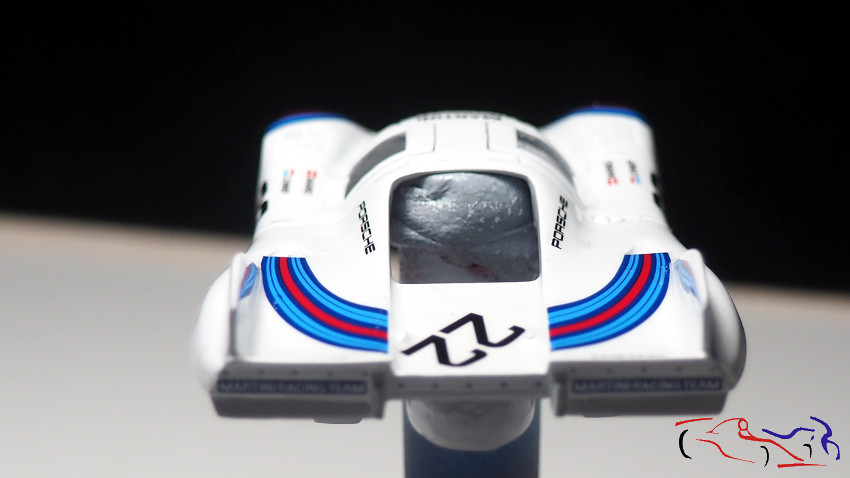
Hola a todos de nuevo. Después de terminar el Mercedes AMG GT3, vuelvo a trabajar sobre este modelo. Comenzamos con varias piezas imprimadas, en las que destaca la parte inferior de capó motor:
Hello everyone again. After finishing the Mercedes AMG GT3, I’m back to work on this model. We’re starting with several primed parts, most notably the lower part of the engine hood:
Otras piezas que hemos modificado son el cockpit y los bajos del chasis, que aunque ya se han eliminado los tubos o cables que venían incluidos en él, aun queda alguna labor para afinarlos. En el caso del chasis, se taparon los huecos realizados a ras de suelo, y se pondrán los nuevos depçositos:
Other parts we’ve modified include the cockpit and the underbody. Although the original pipes and cables have been removed, some work still needs to be done to fine-tune them. In the case of the chassis, the holes made at ground level have been covered, and the new tanks will be installed:
Mas piezas que hemos ido gestionando. El salpicadero, va sujeto por dos extensiones inferiores al chasis. Viendo el proceso que hizo Borja en el suyo, la manera más real de sujetarlo es a las barras antivuelco pediante dos topes de plastico, en donde apoyará dicho salpicadero. De esta manera, podemos eliminar esos dos extensiones inferiores, y asi, tapar un poco los laterales del inferior del salpicadero tal y como aparece en el coche real:
More parts we’ve been working on. The dashboard is held by two lower extensions to the chassis. Looking at the process Borja followed on his, the most realistic way to hold it is to the roll bars using two plastic stops, where the dashboard will rest. This way, we can remove those two lower extensions and thus slightly cover the sides of the lower dashboard, just as they appear on the real car:
Otra de las piezas que era básica para que el capo se pueda abrir, es la pieza que rehice, y que es la base del giro donde el capo bascula. EL problema es que la hice 1 mm más larga en un lado, con lo que, si bien a la vista no se notaba, a la hora de bascular el capó, se descentraba. Por elló, decidí hacer otra para sustituir a la primera que hice:
Another essential piece for the hood to open is the one I remade, which is the pivot point where the hood swings. The problem is that I made it 1 mm longer on one side, so while it wasn’t noticeable, it became off-center when the hood was tilted. Therefore, I decided to make another one to replace the first one I made:
Continuando con esa parte del coche, en una prueba vi que al cerrar el capo con el radiador, no apoyaba completamente en los laterales d ela carrocería porque el radiador sobresalía mucho y hacía de tope. Viendo fotos del coche real, comprobé que el radiador no sobresalia tanto por lo que procedía a eliminar un poco por la parte superior del propio radiador, dejando la parte superior tal cual es. Podemos comprobar en las dos ultimas fotos, como era y como ha quedado después de la operación:
Continuing with that part of the car, during a test, I noticed that when I closed the hood with the radiator, it didn’t fully rest on the sides of the body because the radiator protruded too far and acted as a stop. Looking at photos of the real car, I confirmed that the radiator didn’t protrude that far, so I proceeded to remove a bit from the top of the radiator itself, leaving the upper part as it is. In the last two photos, we can see what it was like and how it looks after the operation:
Nos movemos a las puertas. Deciros que el sistema de imanes para hacer las bisagras me estaba dado muchos problemas porque es muy dificil, pagar los imanes en la posición exacta, por lo que decidí eliminarlos de las puertas y de la carrocería, para sustituirlos por este método, que vi hacer a varios modelistas japoneses: una guia vertical desde la carrocería donde se inserta un tubo fijado a la puerta. . Lo primero era pegar un plástico donde la puerta hará de tope al cerrarla y que desde debajo, se pondrá la guia vertical. Depsués de tomar medidas en cinta de enmascarar, la pasamos a plancha de plástico, cortamos y pegamos a la carrocería:
Moving on to the doors. I’d like to tell you that the magnet system for making the hinges was giving me a lot of trouble because it’s very difficult to place the magnets in the exact position. So I decided to remove them from the doors and the body, replacing them with this method, which I’d seen several Japanese modelers use: a vertical guide from the body into which a tube attached to the door is inserted. The first thing I had to do was glue a piece of plastic where the door would stop when closing, and from underneath, the vertical guide would be placed. After taking measurements on masking tape, we transferred it to a sheet of plastic, cut it, and glued it to the body:
EL siguiente paso es tallar las puertas para que el borde apoye sobre el plástico puesto en la carrocería. Para ello usamos un uitl para marcar una distancia a lo largo del bordetanto por la parte interior d ela puerta, como por el borde de la misma. Para ello, pinto el borde de rojo para saber lo que elimino.
The next step is to carve the doors so that the edge rests on the plastic applied to the body. To do this, we use a tool to mark a distance along the edge, both on the inside of the door and along its edge. To do this, I paint the edge red so I know what I’m removing.
A continuación, cogemos un alfiler de los que se utilizan para fijar los insectos al corcho, lo doblamos a 45 grados y cortamos. Estos alfileres irán colocados y pegados debajo de las piezas de plástico que pusimos en la carrocería como eje de giro de la puerta, con un tope en la parte inferior para que la puerta no se descuelgue. También cortamos el tubo que irá fijado a la puerta:
Next, we take one of the pins used to attach insects to cork, bend it at a 45-degree angle, and cut it. These pins will be placed and glued under the plastic pieces we attached to the body as the door’s pivot axis, with a stop at the bottom to prevent the door from sagging. We also cut the tube that will be attached to the door:
Una vez pegado el eje, fijamos la puerta con cinta de enmascarar en su correcta posición, ponemos el tubo dentro del alfiler, y añadimos entre el tubo y la puerta, una tira con forma de U, larga, para que apoye el tubo y así consigamos una verticalidad correcta respecto a la curvatura de la puerta. Mas adelante, rellenaremos los huecos con masilla epoxi.
Once the axle is glued, we secure the door in its correct position with masking tape, place the tube inside the pin, and add a long U-shaped strip between the tube and the door to support the tube and ensure proper verticality with the door’s curvature. Later, we’ll fill the gaps with epoxy putty.
Y para terminar hoy, nos ponemos con las bisagras del capó. Tal y como comenté en el anterior post #5 de este coche, el capó bascula sobre un tubo horizontal, que en los extremos tiene unas piezas que en su parte final, basculas nuevamente sobre otras que van fijadas al capó. Para hacer las piezas intermedas, despues de corta varias, y hacerles los agujeros por donde girarán, las coloo todas juntas para redondear mejor los extermos y para marcar a la misma distancia, unos agujeros que tienen. Una vez realizadas, las coloco sobre el capó y ahgo también, las pequeñas piezas que giran de nuevo y que van pegadas al capó. Más adelante veré como fijo todo y como lo pinto:
And to finish today, we’ll work on the hood hinges. As I mentioned in post #5 for this car, the hood hinges on a horizontal tube. At the ends, the pieces swing back onto other pieces that are attached to the hood. To make the intermediate pieces, after cutting several and making the holes where they’ll pivot, I place them all together to better round the ends and mark the holes at the same distance. Once made, I place them on the hood and also the small pieces that pivot again and are attached to the hood. Later, I’ll see how I fix everything and how I paint it:
Esto es todo por ahora, gracias por ver y comentar!!
That’s all for now, thanks for watching and commenting!!